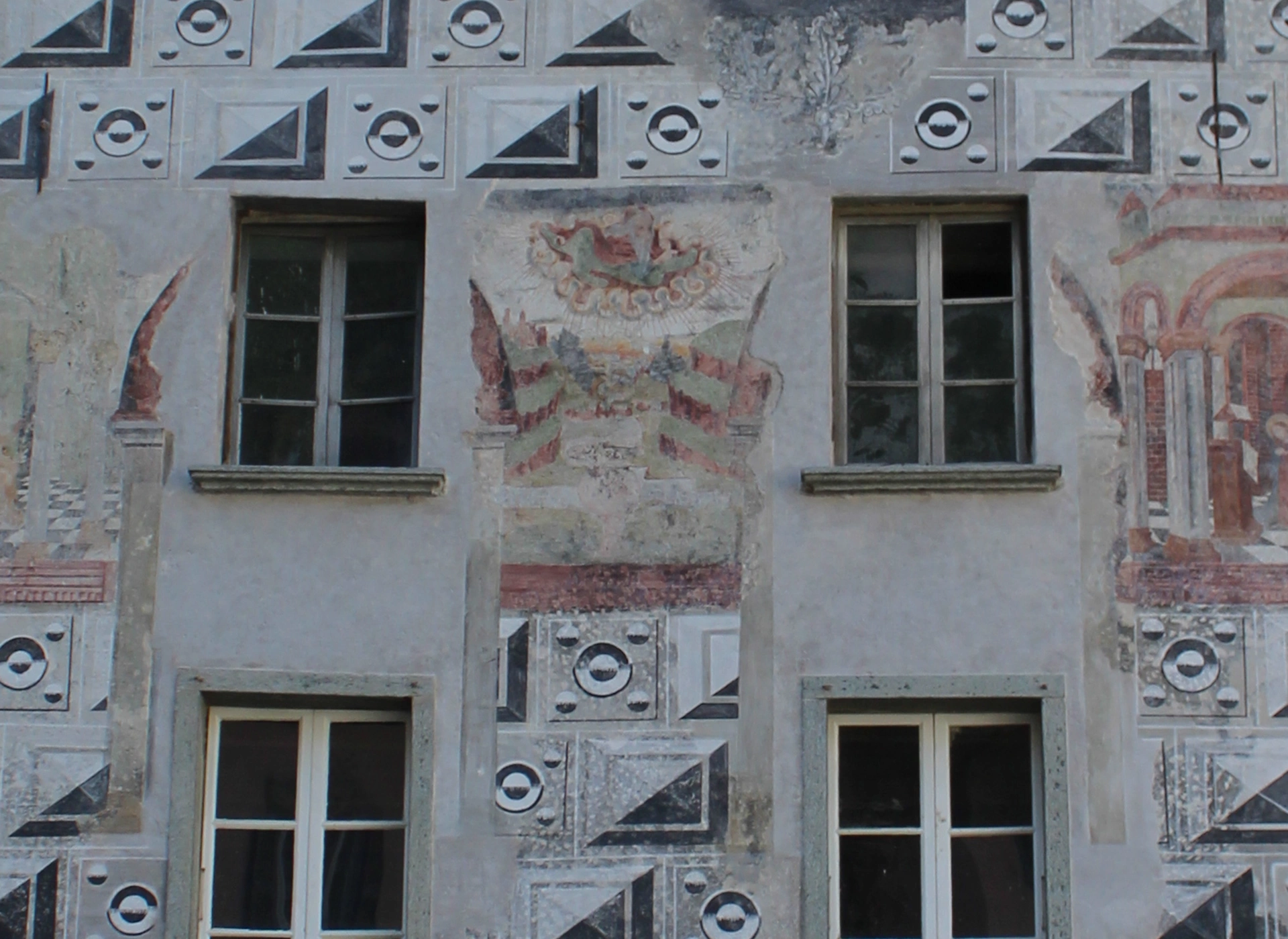
The paintings on the buildings of Chiavenna’s historic center tell the story of the taste and style of an elegant town, whose nobility also expressed itself through the splendid frescoes that have resurfaced in recent years.
That Chiavenna’s historic center is the best preserved in the province of Sondrio is not a matter of opinion. Partly burned by the neighboring Grisons in 1486 during one of their probing raids, the young State would go on to conquer the town and its valley in 1512 and would promote its Renaissance reconstruction. Typical and numerous are the soapstone portals with round arches or lintels, characterized by apotropaic masks (monstrous figures meant to ward off evil spirits) and by coats of arms, often defaced at the end of the 1700s in the name of “égalité” by the Cisalpine forces who succeeded the Grisons. But what truly sets them apart are the carved inscriptions of religious or moral themes, in Latin or Italian, complete with dates: from 1517, the earliest, up to the second decade of the 1600s, with a few later examples in the following century. This was also a custom found in nearby Bregaglia, today part of Switzerland. Religious figures were also once painted on the facades, almost all of which have since vanished — but in recent decades, thanks to municipal regulations requiring preliminary test patches before restoring walls, the original sixteenth-century decoration, which had been completely whitewashed over, was recovered in two cases.
Via Dolzino no. 57
The first case, along Via Dolzino at numbers 55–57, dates back to 1999–2000 and involves a facade decorated in full except for the ground floor: monochrome paintings depicting Kings Henry III and Henry IV of France, commissioned in 1591 — as noted beneath the figure of the first king — since both rulers were known for protecting the Huguenots, as the French Calvinists were called. This choice was motivated by the fact that the commissioner was a Protestant owner from the Stampa family, to whom the house on the right also belonged, marked with the date 1588 and the family coat of arms, alongside that of his wife, a Camogli from Piuro. Below a band of bucolic scenes, two symmetrical panels depict biblical episodes in which two women saved their Jewish people: Judith, who neutralized the Assyrian siege by deceitfully killing General Holofernes — whose head appears in the sack held by the handmaid on the right — and Esther, who through prayer dissuaded her husband Ahasuerus (King Xerxes) from exterminating the Jews. The soapstone portal on the ground floor bears the name of Andrea Cortino Gaudenzetti, who became the owner of the house in 1664. The sun carved at the center refers to this family’s coat of arms.
Piazza Pestalozzi nos. 1 and 2
The second, more recent discovery concerns a facade at “il Cantón” (Piazza Pestalozzi, numbers 1 and 2). On the three floors above ground level, a series of frescoes came to light in 2022. Between two floors decorated with monochrome motifs — diamond-shaped prisms alternating with circular patterns featuring four smaller circles at the corners — three scenes inspired by the Annunciation have emerged. On the left, the angel Gabriel, holding the customary lily, stands on a black-and-white checkered floor in a vaulted room, announcing the birth of Jesus to the Madonna, who kneels at the other end, hands crossed over her chest, before a lectern, within a portico with red brick walls and Corinthian-capitaled columns. At the center, the figure of God the Father has his right hand turned toward the Madonna, within a cloud from which rays radiate down toward the world below, represented by a landscape of houses and a three-tiered meadow, through which a stream flows. Everything points to a dating of the paintings to the 1500s. The soapstone portal giving access from the side street, Via Suor Maria Laura Mainetti, also bears the date 1598 carved at the center of the arch. These two house walls in the heart of Chiavenna are the only surviving examples of sixteenth-century frescoes in the historic center, of considerable artistic and visual value, to which others may yet be added — as already suggested by test patches carried out on the Lumaga houses (nos. 87 and 89) and the Stampa houses (nos. 60 and 62) on the same “Paart de mèz.” Together with the “Protestant” wall mentioned earlier, this constitutes the second known example of sixteenth-century frescoes in the historic center, of significant historical, artistic, and visual value. These extraordinary decorations, reflecting the taste and sensibility of the city’s wealthiest families during an important period in Chiavenna’s history, are well worth close observation.
Piazza Caduti per la Libertà, 4
23022 Chiavenna (SO)
0343 37485
consorzioturistico@valchiavenna.com